As a global buyer, how do you accurately evaluate and select the right custom sneaker factory? The key to finding top-tier sneaker manufacturer options lies in assessing their custom OEM capabilities, BOM cost structures, and physical performance quality control systems. An exceptional chinese sneaker manufacturer must not only possess scalable production lines, but also establish a comprehensive quality assurance workflow.
Whether you are an emerging fashion brand or an established footwear retailer, having a clear grasp of the end-to-end supply chain control logic—from design prototyping to bulk quality inspection—is the core prerequisite to ensuring timely project completion and avoiding costly material losses when searching for a sneaker supplier or filtering reliable sneaker suppliers in china.
Key Takeaways
- Partnership Model Selection: Startup brands are advised to begin with ODM/Private Label (MOQ 300–500 pairs); brands with proprietary designs should opt for deep OEM customization (MOQ 500 pairs and up).
- Core Quality Benchmarks: Qualified casual sneaker outsole peel strength must reach ≥\ge≥ 70 N/cm, and flex resistance testing must endure 40,000+ flex cycles without cracking.
- Development & Production Lead Times: Basic sample development takes 7–14 days; if new outsole tooling is required, mold development takes 30–45 days; bulk production lead time spans 30–60 days.
- Risk Avoidance Essential: Prior to bulk production, parties must sign off on a “Golden Sample” as the sealed standard and mandate factory execution of AQL 2.5 international inspection protocols.
Sneaker Manufacturing Models and Cost Structures
When searching for a footwear factory, buyers must first choose the manufacturing partnership model that best aligns with their brand budget, design capabilities, and market trial tolerance.
Different operational models exhibit distinct variations in minimum order quantities (MOQ), development cycles, and capital thresholds:
| Partnership Model | Target Audience | Core Advantages & Constraints | MOQ Requirement | Lead Time |
|---|---|---|---|---|
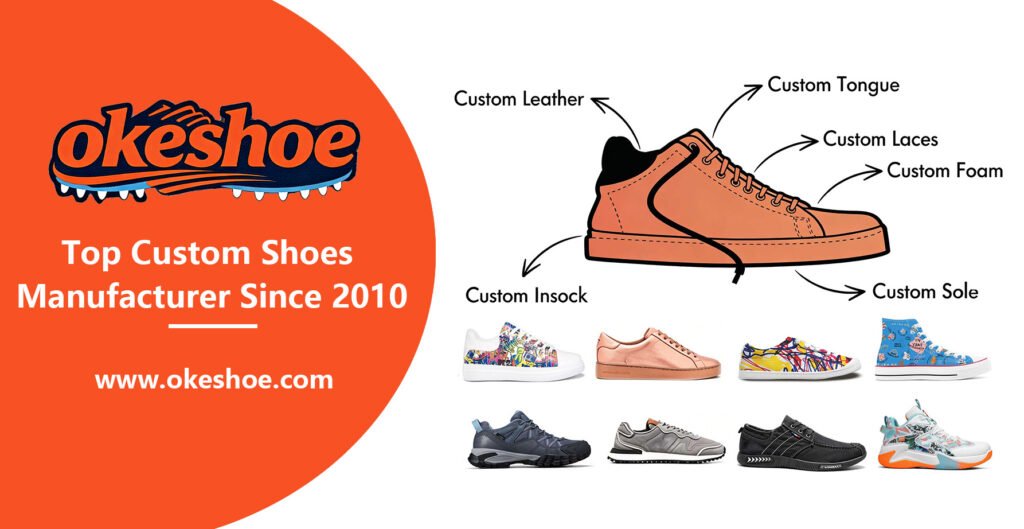
| OEM (Deep Customization) | Brands with complete Tech Packs and unique design sketches. | Pros: Supports proprietary lasts and custom outsole molds; maximum design freedom. Cons: High upfront mold cost ($1,500–$3,500 per size mold). | 500–1,000 pairs/style | Longer (includes mold opening time) |
| ODM (Design Adaptation) | Brands seeking fast turnover, minor upper material, or colorway tweaks. | Pros: Direct use of existing open-mold outsoles, avoiding high mold fees. Cons: Outsole and last silhouettes are constrained by open molds. | 300–500 pairs/style | 50% shorter lead time |
| Private Label (Stock Branding) | E-commerce brands testing market traction rapidly. | Pros: Fastest turnaround; apply custom logos or insoles to stock shoes. Cons: Lower product differentiation. | 100–300 pairs | Fastest delivery |
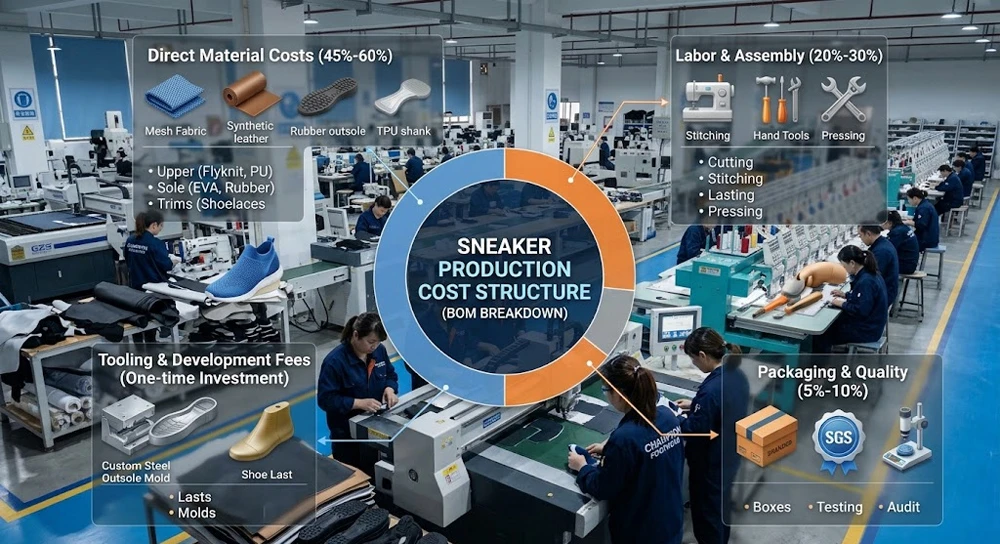
Understanding the Bill of Materials (BOM) cost breakdown equips procurement teams with leverage during commercial negotiations. The production cost of a casual sneaker typically splits into 4 core components:
- Direct Material Costs (45%–60%): Encompasses upper fabrics (flyknit, genuine leather, PU, mesh), mid/outsoles (EVA, TPU, rubber), and trims (shoelaces, insoles, reinforcement counters).
- Labor & Assembly (20%–30%): Covers material cutting, upper stitching, lasting, and adhesive cement pressing processes.
- Tooling & Development Fees (One-time Investment): Proprietary bottom molds are charged per size; select factories rebate mold costs once bulk order volumes reach agreed thresholds.
- Packaging & Quality Testing (5%–10%): Custom shoe boxes, tissue paper, hangtags, and third-party lab testing or factory audit fees.
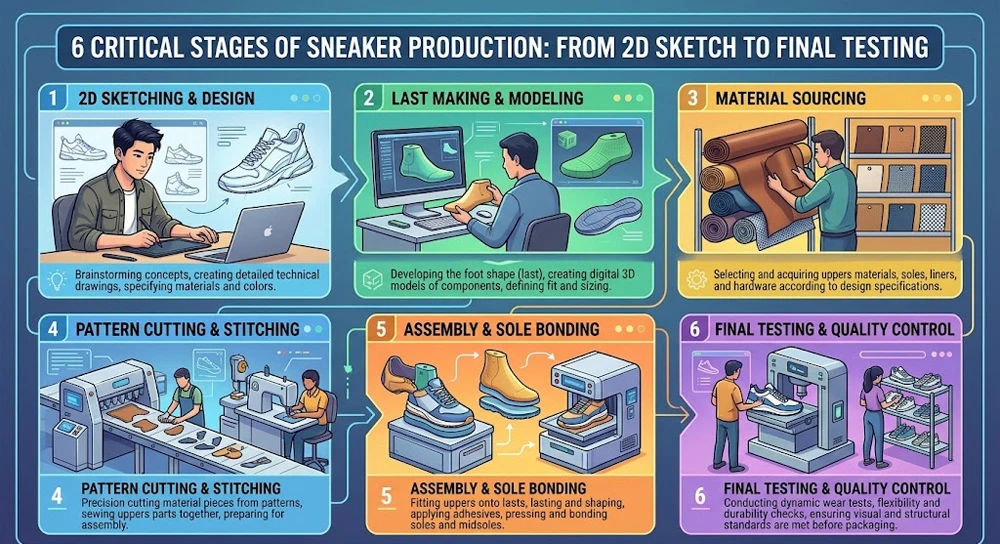
6 Critical Stages of Sneaker Production
A structured footwear manufacturing process effectively mitigates common risks such as discrepancies between prototype samples and bulk production. Converting a 2D sketch into a mass-producible shoe requires 6 rigorous steps:
- Tech Pack Audit & Last Engineering: Translating 2D/3D design files into precise last dimensions and pattern templates to build the foundational shoe geometry.
- Prototyping & Fit Sampling: Producing Proto and Fit Samples to calibrate sizing gradation and ergonomics before final signing off on a Golden Sample.
- Material Procurement & Inbound Inspection: Bulk purchasing upper and bottom materials, subjecting them to physical tensile tests, colorfastness checks, and environmental compliance (e.g., REACH).
- Precision Cutting & Upper Stitching: Utilizing automated CNC cutting beds for precision paneling, followed by skilled stitchers assembling uppers, piping, and reinforcements.
- Outsole Assembly & Cement Bonding: Accurately regulating water-based adhesive drying temperatures and pressing machine pressures for enduring upper-to-sole bonding.
- Laboratory Physical Testing & AQL 2.5 Inspection: Sampling finished footwear for physical performance verification prior to final packaging and release under AQL 2.5 standards.
Factory Quality Control & Third-Party Certifications
Consistent quality is the lifeline of any footwear brand. Professional footwear factories must establish rigorous quality control procedures to ensure every outgoing sneaker meets international retail standards.
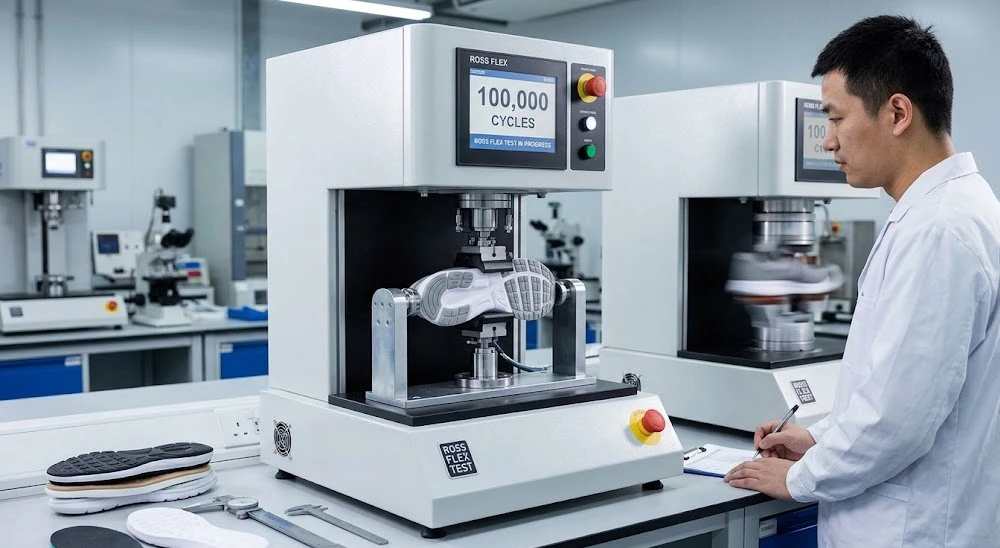
From raw material intake to final packaging, finished shoes must pass multiple laboratory physical tests:
- Outsole Peel Strength Test: Testing bonding durability between uppers and outsoles using tensile testers; passing standard requires ≥\ge≥ 70 N/cm.
- Flex Resistance Testing: Finished shoes must endure 40,000+ continuous flex cycles on flexing machines without cracking or delamination.
- Colorfastness & UV Yellowing Resistance: Upper and outsole materials must pass UV yellowing chambers to prevent discoloration during transoceanic shipping or shelf display.
Executing AQL 2.5 international sampling standards post-production, alongside third-party testing agency verifications (such as SGS, BV, TUV), serves as the core mechanism to ensure zero-defect shipment.
4 Core Criteria for Evaluating Sneaker Suppliers
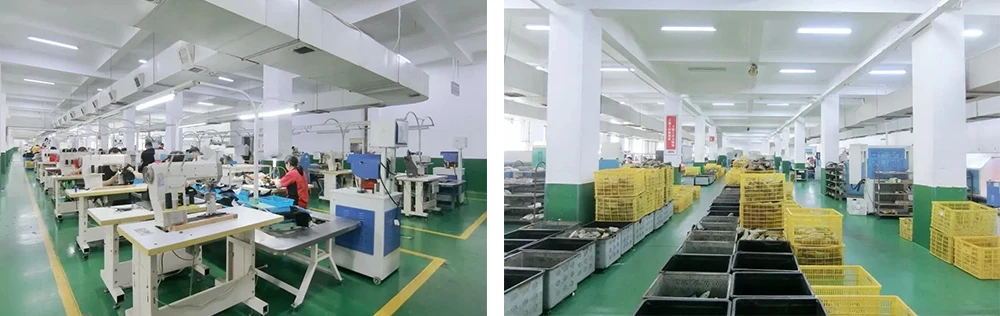
When searching for a reliable sneaker supplier, procurement managers need to comprehensively evaluate R&D capabilities, production capacity, quality control systems, and supply chain stability. Leveraging 16 years of experience, Okeshoe has established a mature production and delivery network that supports rapid order replenishment, helping brands steadily capture market share.
To evaluate whether a sneaker suppliers in china is qualified, it is recommended to assess them across the following four core dimensions:
- R&D and Tooling Capabilities: Whether the factory retains in-house shoe last master technicians and 3D design modeling software to rapidly convert conceptual sketches into production-ready Tech Packs.
- Physical Testing & Certifications: Whether the factory has passed audits and obtained certifications from authoritative third-party inspection bodies, such as SGS, BV, and TUV.
- Production Line Setup & Capacity: Whether it maintains independent stitching and lasting assembly lines capable of guaranteeing upper stitching precision and outsole bonding quality during bulk production.
- Supply Chain Flexibility & Low MOQ: Whether it supports a low minimum order quantity of 500 pairs (MOQ), balancing market-testing needs for startup brands with high-volume replenishment for established labels.
| Evaluation Dimension | Qualified Factory Standard | Okeshoe Capability Benchmarks |
|---|---|---|
| Plant & Scale | Independent facility with complete lasting lines | 10,000 m² factory area, 200+ production workers |
| Production Lines | Fully paired stitching and lasting lines | 150 stitching lines, 10 durable lasting lines |
| Annual Output & Lead Time | Scalable capacity for bulk deliveries | Annual output exceeding 1.5 million pairs, supporting rapid replenishment |
| Authoritative Quality Certification | Third-party inspection reports available | Certified by SGS, BV, and TUV |
💡 Frequently Asked Questions
Q: How much does it cost to develop a custom sneaker outsole mold?
Ans: Sneaker outsole molds are typically machined using steel or aluminum CNC processes. The tooling fee for a single shoe size generally ranges between $1,500 and $3,500, depending on structural complexity (such as air cushions, TPU anti-torsion shanks, or multi-color dual-density phylon). Full-size run tooling costs vary based on total size counts.
Q: What is the typical lead time for sneaker sample development?
Ans: If utilizing a factory’s existing open-mold outsoles and lasts, prototype development generally takes 7 to 14 days. If custom outsole molds and dedicated shoe lasts must be built from scratch, mold manufacturing adds an extra 30 to 45 days.
Q: How do you ensure bulk production quality matches the approved sample?
Ans: Both parties must sign off on a “Golden Sample” as the sealed reference standard. Quality acceptance metrics (e.g., outsole peel strength ≥\ge≥ 70 N/cm) should be explicitly written into the manufacturing contract, mandating pre-shipment AQL 2.5 inspection protocols.
Q: Do footwear factories support sustainable and eco-friendly sneaker materials?
Ans: Yes. Factories can supply GRS (Global Recycled Standard) certified recycled polyester uppers, natural rubber outsoles, bio-based EVA midsoles, and non-toxic water-based eco-glues to help brands comply with strict environmental regulations in Western markets.
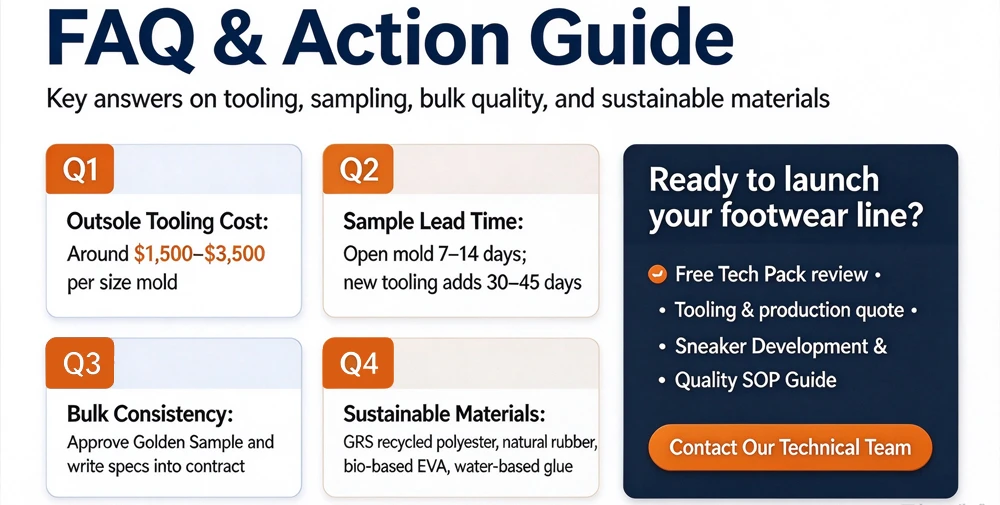
Preparing to launch your next footwear line? Contact our technical team today to evaluate your Tech Pack for free and receive an instant tooling & production quote!
Need reference guidelines on industry specs? Click here to request our free Sneaker Development & Quality SOP Guide.
| OEM&ODM Factory | Email: sandy@okeshoe.com | WhatsApp:+86 13328871615 |
Building a successful sneaker brand relies on a clear understanding of manufacturing models, BOM cost control, physical testing benchmarks, and quality inspection protocols. By systematically planning development timelines, allocating mold budgets, and enforcing transparent quality oversight, brands can seamlessly transition design concepts into market-ready products.