Selecting the right upper material is the most decisive factor when engineering a successful casual footwear lineup. As a global brand or footwear wholesaler, your choice between genuine leather and synthetic microfiber leather determines your bill of materials (BOM), production lead times, and end-user customer satisfaction.
Whether you are launching a minimalist sneaker collection or expanding a bulk wholesale fashion range, understanding material specs is vital. This comprehensive guide breaks down physical properties, cost efficiency, and sourcing strategies from a leading casual shoes factory to help you make data-driven purchasing decisions.
Key Takeaways
- Material Performance: Microfiber leather delivers high material utilization (95%+) and superior tear strength, whereas genuine leather offers unrivaled natural breathability (>5 mg/cm²·h) and luxury brand appeal.
- Eco & Tech Innovation: Advanced microfiber utilizes waterborne PU and GRS-certified recycled fibers, providing a water-resistant, crack-proof synthetic alternative for modern footwear.
- Cost & Budget Strategy: Microfiber reduces upper BOM costs by 20% to 30%, making it ideal for high-volume lines, while genuine leather supports higher retail price points (40%+ margin markup).
- Source Factory Partner: Partnering with an experienced casual shoes manufacturer like Okeshoe provides 16 years of expertise, a 10,000㎡ facility, BV/TUV/SGS certifications, and flexible 500-pair MOQs for seamless bulk production.
Comprehensive Comparison: Genuine Leather vs. Microfiber
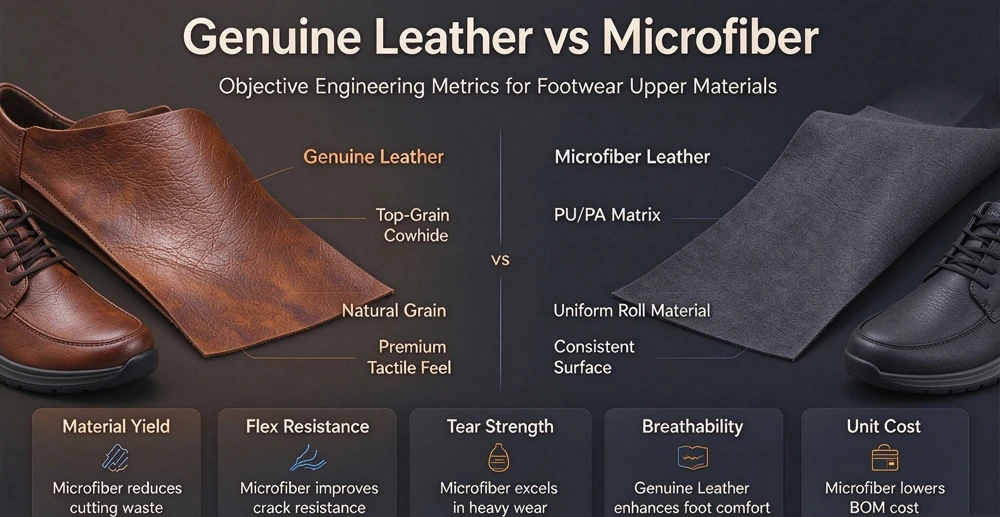
Evaluating upper materials requires objective engineering metrics rather than subjective aesthetic preferences. Top-grain cowhide relies on natural collagen fiber bundles for moisture dissipation, while engineered microfiber utilizes a 3D polyamide micro-mesh matrix impregnated with polyurethane to replicate natural fiber networks.
| Performance Metric | Genuine Leather (Top-Grain Cowhide) | Microfiber Leather (PU/PA Matrix) | B2B Procurement Impact |
| Material Yield Rate | 60% – 70% (Irregular shape & natural defects) | 95% – 98% (Uniform roll width 1.37m) | Microfiber reduces cutting waste by 30% |
| Flex Resistance | 100,000+ Cycles (SATRA TM55) | >200,000 Cycles (SATRA TM55) | Microfiber offers superior crack resistance |
| Tear Strength | 30 – 50 N/mm | 60 – 80 N/mm | Microfiber excels in heavy-wear casual shoes |
| Breathability | 5 – 8 mg/cm²·h | 1.5 – 3.0 mg/cm²·h | Genuine leather ensures superior foot comfort |
| Unit Material Cost | High ($2.50 – $4.50 / sq.ft.) | Moderate ($0.80 – $1.80 / sq.ft.) | Microfiber lowers BOM cost significantly |
While natural hide grain creates a premium sensory experience, its variable shape increases cutting scrap. Microfiber’s continuous roll format allows automated cutting machinery to maximize yield efficiency and streamline large-scale OEM manufacturing.
💡 Frequently Asked Questions
Which material offers better cost-efficiency for bulk custom casual shoes manufacturing?
Microfiber leather provides higher cost-efficiency for bulk manufacturing due to its 95%+ material yield, uniform roll width, lower scrap rate, and 30% to 50% lower raw material unit cost compared to genuine top-grain hide.
Evaluating Microfiber Durability and Sustainability
Modern microfiber leather represents a significant technological leap over traditional PVC or basic PU synthetics. For commercial buyers sourcing from a reliable casual shoes supplier, microfiber delivers industrial-grade physical durability alongside rising eco-friendly credentials.
Key structural advantages and environmental features include:
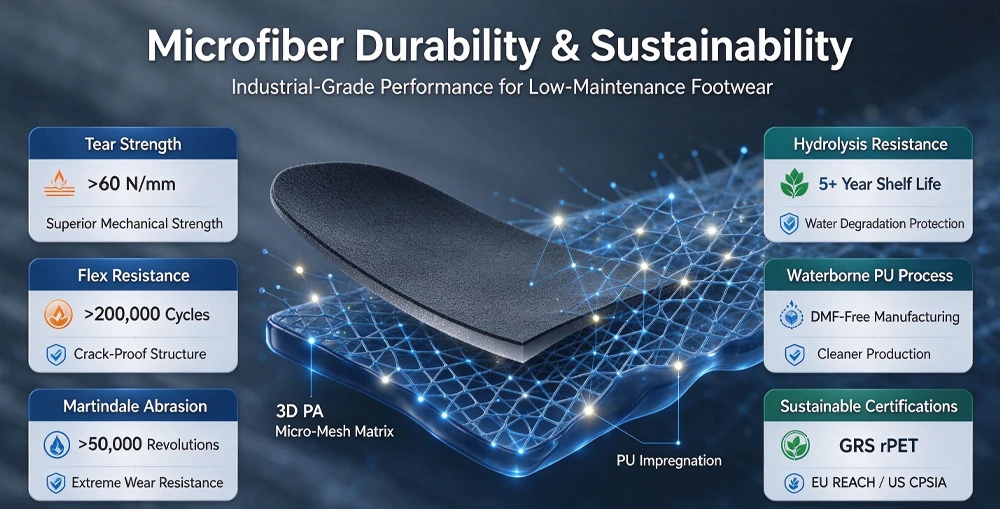
- Superior Mechanical Strength: Features a 3D polyamide (PA) micro-mesh matrix impregnated with polyurethane (PU), delivering tear strength exceeding 60 N/mm.
- Extreme Abrasion Performance: Scores over 50,000 revolutions on the Martindale Abrasion Test and withstands >200,000 flex cycles without surface cracking.
- Hydrolysis and Shelf-Life Resistance: Completely resistant to water degradation, offering a 5+ year store shelf aging lifecycle without peeling or surface flaking.
- Eco-Conscious Manufacturing: Produced via eco-friendly waterborne PU processes that eliminate harmful organic solvents like DMF (Dimethylformamide).
- Sustainable Material Certifications: Fully compatible with Global Recycled Standard (GRS) rPET recycled fibers, meeting strict EU REACH and US CPSIA environmental compliance.
For footwear brands aiming for lower defect rates and zero animal-derived materials, microfiber leather provides an ultra-consistent, highly durable solution that scales seamlessly across automated production lines.
💡 Frequently Asked Questions
How does microfiber leather perform in terms of durability and weather resistance?
Microfiber leather outperforms natural leather in tear strength (>60 N/mm) and flex resistance (>200,000 cycles). It is inherently water-resistant, crack-proof, and hydrolysis-resistant for over 5 years, making it ideal for low-maintenance casual footwear.
Mastering Genuine Leather Texture and Breathability
Despite rapid advances in synthetic textiles, natural genuine leather remains the gold standard for premium, luxury, and heritage footwear collections. Its unique biological structure cannot be fully duplicated by synthetic chemistry.
Core features that make genuine leather essential for premium lines include:
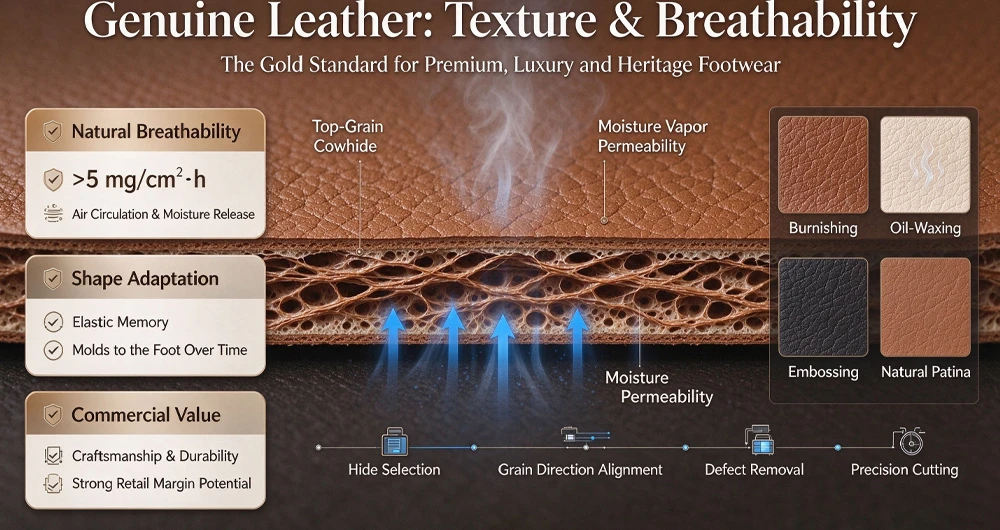
- Natural Moisture Vapor Permeability: Micro-porous collagen fiber network allows air circulation and moisture vapor discharge exceeding 5 mg/cm²·h.
- Ergonomic Shape Adaptation: Features natural elastic memory, allowing upper panels to mold to the wearer’s unique foot shape over time for maximum comfort.
- Elevated Commercial Value: Commands a strong consumer perception of craftsmanship and durability, enabling brands to achieve 40%+ higher retail price margins.
- Rich Surface Finishing: Compatible with specialized artisan treatments including burnishing, oil-waxing, embossing, and natural patina aging.
Working with genuine leather requires strict industrial quality control during cutting and skiving. Experienced factory craftsmen must carefully inspect each hide to align grain direction and remove structural weak points before assembly.
💡 Frequently Asked Questions
Why do premium footwear brands still prefer genuine leather for casual shoes?
Premium brands prefer genuine leather for its superior natural breathability (>5 mg/cm²·h), moldable comfort, luxurious tactile feel, and high perceived value, which enables retailers to command 40%+ higher retail price points.
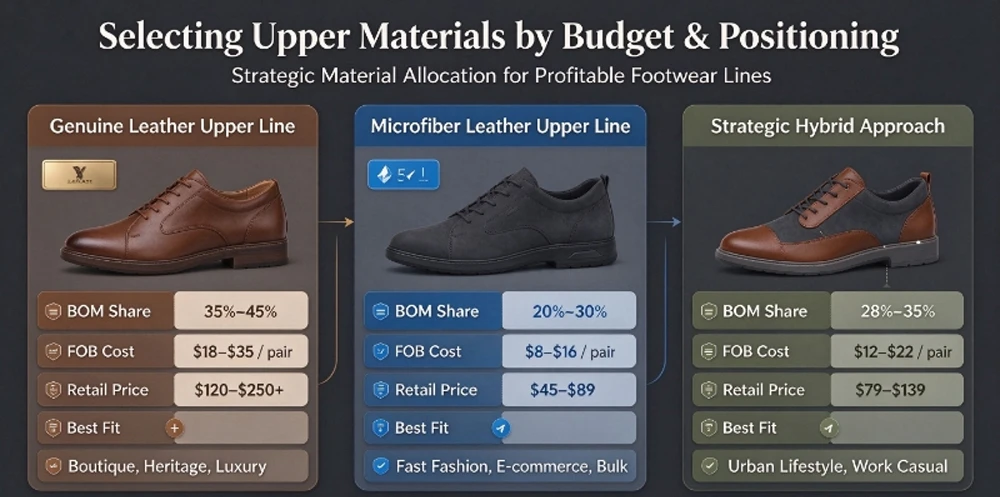
Selecting Upper Materials Based on Budget
Balancing material quality with target retail price points is essential for footwear brand profitability. A successful product line requires strategic material allocation based on market positioning and production scale.
| Cost & Positioning Parameter | Genuine Leather Upper Line | Microfiber Leather Upper Line | Strategic Hybrid Approach |
| BOM Share (Upper Material) | 35% – 45% of Total BOM | 20% – 30% of Total BOM | 28% – 35% of Total BOM |
| Estimated Factory FOB Cost | $18.00 – $35.00 / pair | $8.00 – $16.00 / pair | $12.00 – $22.00 / pair |
| Target Retail Price Point | $120.00 – $250.00+ | $45.00 – $89.00 | $79.00 – $139.00 |
| Best-Fit Brand Category | Boutique, Heritage, Luxury | Fast Fashion, E-commerce, Bulk | Urban Lifestyle, Work Casual |
Key commercial decision rules for footwear procurement managers:
- Fast Fashion & Mass Market: Choose microfiber leather to minimize unit cost, ensure zero grain defect scrap, and maintain low FOB pricing for high-volume sales of custom casual shoes.
- Premium & Heritage Lines: Invest in top-grain genuine leather to establish premium retail market positioning and capture maximum brand equity markup.
- Zoned Hybrid Construction: Combine genuine leather on high-impact focal panels (such as the shoe vamp and eyestay) with microfiber internal linings to balance cost and wear comfort.
💡 Frequently Asked Questions
How can footwear buyers optimize unit costs without sacrificing upper quality?
Buyers can optimize costs by selecting high-grade microfiber for high-volume orders to achieve 20% to 30% lower BOM costs, or by adopting a hybrid construction using genuine leather on key outer panels and microfiber for internal linings.
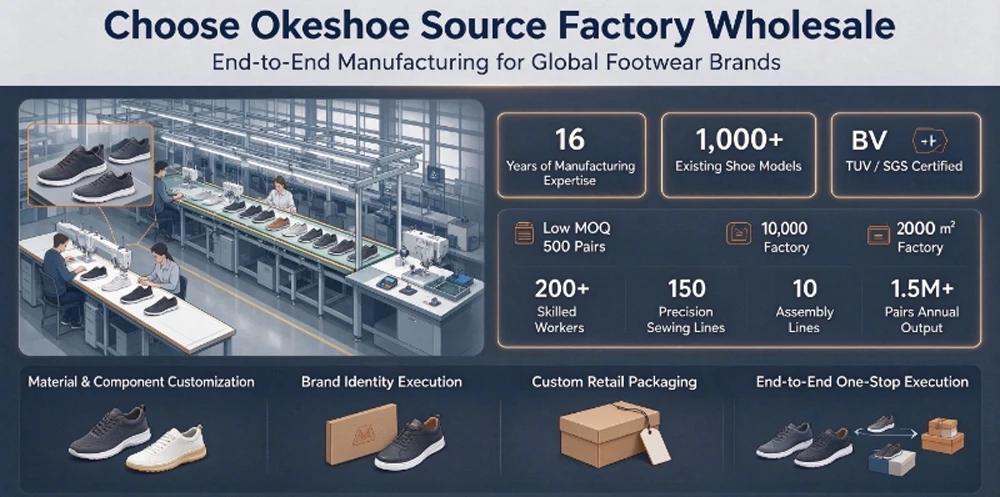
Choose Okeshoe Source Factory Wholesale
Executing a successful casual footwear line requires a dependable, transparent manufacturing partner. As a leading manufacturer based in China, Okeshoe provides complete, end-to-end manufacturing and wholesale supply solutions for global buyers.
Key Reasons Global Footwear Wholesalers Partner with Okeshoe
- 16 Years of Manufacturing Expertise: Proven track record collaborating with over 300 global clients and 100+ international brand partners to build profitable footwear lines.
- 1,000+ Existing Shoe Models: Extensive private-label shoe catalog enabling fast product development and accelerated market entry.
- Authoritative Quality Certifications: Production processes audited and certified by top international inspection agencies, including BV, TUV, and SGS.
- Low & Flexible MOQ (500 Pairs): Low minimum order quantities allow emerging brands and wholesalers to test market demand with minimal inventory risk.
- Robust Wholesale Capacity & Factory Scale: Operating a modern 10,000 square meter factory with 200+ skilled workers, 150 precision sewing lines, and 10 durable assembly lines. With an annual output exceeding 1.5 million pairs, Okeshoe delivers strong volume capacity and rapid order replenishment for global distributors.
- Full-Spectrum OEM/ODM Customization Services:
- Material & Component Customization: Tailored uppers, soles, insoles, heels, hardware, and sustainable eco-fabrics.
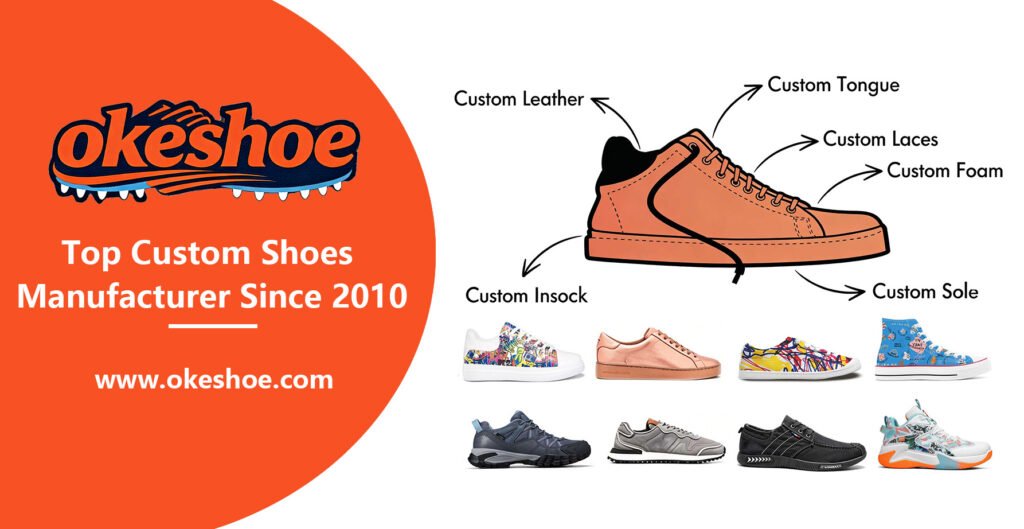
- Brand Identity Execution: Custom embossed logos, custom shoe tongues, printed insoles, and personalized laces.
- Custom Retail Packaging: Branded shoe boxes, custom tissue wrap, and specialized hangtags.
- End-to-End One-Stop Execution: Seamless workflow from initial sample creation to inline quality control and global shipping.
💡 Frequently Asked Questions
What custom manufacturing services and production capacities does Okeshoe offer?
Okeshoe provides complete one-stop OEM/ODM footwear manufacturing with an annual capacity of 1.5+ million pairs, audited by BV, TUV, and SGS. We offer full customization across styles, materials, logos, soles, and packaging with a low MOQ of 500 pairs.
Ready to elevate your footwear collection with industry-leading upper materials and reliable factory production? Contact Okeshoe today to request free material swatches or start building your custom sample!
| OEM&ODM Factory | Email: sandy@okeshoe.com | WhatsApp:+86 13328871615 |
Choosing between genuine leather and microfiber leather ultimately depends on your brand positioning, budget constraints, and market strategy. Genuine leather offers unmatched natural breathability and luxury appeal, while microfiber leather provides exceptional physical durability, eco-friendly options, and maximum cost efficiency.
Partnering with an experienced manufacturer like Okeshoe ensures seamless execution regardless of your material choice. Backed by 16 years of expertise, a 10,000㎡ factory facility, BV/TUV/SGS certifications, and a 1.5 million pair annual capacity, Okeshoe provides the ideal manufacturing foundation to scale your casual shoe business globally.