Key Takeaways
- Material selection drives costs: Uppers account for 38–45% of FOB cost, while midsoles and outsoles contribute 20–25%.
- Upper materials involve cost trade-offs: Knit, mesh, canvas, and synthetic leather differ in setup costs, durability, and price positioning.
- Sole specifications determine performance: Foam density, compression set, and outsole compounds affect cushioning, grip, and wear resistance.
- The right production model controls investment: Private label, semi-custom, and full custom differ in tooling costs, MOQ, and lead times.
- Okeshoe supports cost-effective production: With 16 years of experience, a 500-pair MOQ, and an annual capacity of 1.5 million pairs, Okeshoe offers flexible material sourcing and manufacturing support.
Six material decisions set the price of custom sneakers, and only two of them are usually negotiated. Buyers spend weeks on unit price and minutes on upper thickness, midsole density, outsole compound and lining — the four specifications that decide whether the shoe survives a season or comes back as a return. This guide walks through each decision in the order a factory costs it, with the test methods that turn an opinion into a number.
The commercial context matters here. According to the World Footwear Yearbook 2024, global production exceeds 22 billion pairs a year and athletic styles now dominate volume growth, which means material substitution has become the main competitive lever in the category. Every factory can offer you a cheaper shoe; far fewer can tell you precisely what you gave up to get it.
What Actually Drives Custom Sneakers Cost
Cost on custom sneakers stacks in a predictable order. In our own costing for a mid-range cupsole sneaker, the upper (materials plus cutting and stitching) runs 38–45% of FOB, the midsole and outsole 20–25%, lining and insock 5–8%, assembly and finishing 12–18%, packaging 3–5%, and factory margin 8–15%. When a quote arrives 15% under the market, it is almost never the margin that moved — it is the upper.
That matters because the upper is also the only part the customer can see and touch. A custom sneakers factory cutting 0.2 mm from a suede backing or switching a 75D mesh for a 50D mesh saves real money and creates a shoe that photographs identically but creases differently within six weeks.
| Cost element | Share of FOB | Where buyers usually cut | What it costs later |
|---|---|---|---|
| Upper material and stitching | 38–45% | Thinner suede, lighter mesh | Creasing, tearing at the eyestay |
| Midsole and outsole | 20–25% | Lower density EVA, TPR instead of rubber | Compression set, slip complaints |
| Lining and insock | 5–8% | Non-woven instead of mesh | Odour, lining failure |
| Assembly and finishing | 12–18% | Fewer stitch rows | Adhesive failure at the toe |
| Packaging | 3–5% | Single-wall carton | Transit damage |
For custom made athletic shoes, the fastest way to see this on paper is to ask for a cost breakdown against three material scenarios rather than one quote. A professional manufacturer should be able to compare baseline, upgraded and value-engineered specifications, helping buyers identify where material adjustments can reduce costs without compromising essential performance.
💡 Frequently Asked Questions
How much do custom sneakers cost per pair?
For a 500-pair run, USD 14–26 FOB is typical for canvas and mesh constructions, USD 22–38 for cupsole sneakers with phylon midsoles, and USD 35+ once knit uppers or supercritical foams are specified.
Uppers: Knit, Mesh, Canvas or Leather
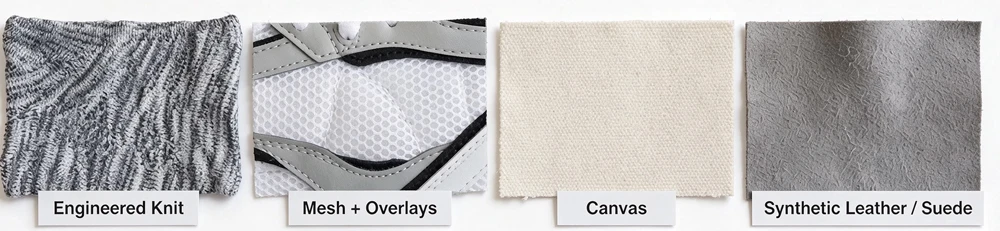
Four upper families cover almost every custom sneakers brief, and each behaves differently on cost, tooling and lead time. Engineered knit needs a programming step and a flat-knit machine, so it carries a setup cost but removes cutting waste and lining in many constructions. Mesh is the workhorse of custom running shoes: cheap per square metre, breathable, and available in dozens of weights, which is exactly why the weight must be specified in denier rather than described as “breathable mesh”.
Canvas is the lowest-tooling option and the most forgiving for small runs, which is why it dominates entry-level programmes. Synthetic leather and suede deliver structure and premium perception, but two variables decide everything: thickness in millimetres and backing quality. A 1.2 mm PU-coated fabric with a knitted backing will delaminate at the flex point long before a 1.4 mm equivalent with a non-woven backing.
| Upper | Setup cost | Best for | Watch for | Indicative FOB impact |
|---|---|---|---|---|
| Engineered knit | High (programming) | Lightweight runners, slip-ons | Recovery after stretching | +8–15% |
| Mesh + synthetic overlays | Low | Volume running and training | Denier not specified | Baseline |
| Canvas | Very low | Entry price, print-led ranges | Colourfastness to rubbing | −10–15% |
| Synthetic suede / leather | Medium | Lifestyle and court styles | Thickness and backing | +6–12% |
A practical habit: ask for the material spec sheet with thickness, weight in gsm or denier, backing type and supplier code for every component. Then ask for the same sheet for the substitute the factory proposes when it offers a lower price. Comparing two documents is faster and more honest than comparing two shoes in a showroom.
A reliable manufacturer should also be able to coordinate material selection with the intended shoe construction, target market and retail positioning, rather than recommending materials based on price alone.
💡 Frequently Asked Questions
Which upper material is best for custom sneakers?
Engineered knit is suitable for lightweight running shoes, mesh works well for breathable athletic footwear, canvas offers a cost-effective option for casual styles, and synthetic leather or suede provides greater structure for lifestyle and court shoes. The best choice depends on the required performance, appearance and target price.
Midsoles and Outsoles: Where 20% Hides
The midsole is the least visible and most consequential part of a sneaker. EVA moulded at 0.18–0.25 g/cm³ feels soft and packs out quickly; phylon (compressed EVA) holds shape better at a similar weight; PU delivers the best rebound and the worst hydrolysis risk in humid climates; TPU and supercritical foams sit at the top of the cost curve. Two numbers separate them in a spec sheet: density and compression set.
Compression set is measured to ASTM D395 — the percentage of thickness a foam loses after sustained load. Above roughly 35% at 50°C, a midsole will visibly flatten inside a season. Hardness is measured to ASTM D2240 on the Shore C scale, where a 45–55 Shore C footbed feels soft in hand and a 60–65 Shore C base holds structure. Ask for both numbers, in writing, for the exact foam you are buying.
| Midsole | Density (g/cm³) | Compression set | Cost | Verdict |
|---|---|---|---|---|
| Standard EVA | 0.18–0.25 | 35–45% | Low | Fine for fashion, weak for running |
| Phylon (compressed EVA) | 0.20–0.30 | 25–35% | Medium | Best value for volume athletic |
| PU | 0.35–0.50 | 15–25% | High | Great rebound, hydrolysis risk |
| Supercritical foam | 0.10–0.18 | 10–20% | Very high | Premium running only |
On custom sneakers, outsole choice is simpler and more binary. Rubber (natural or synthetic blend) gives grip and abrasion resistance; TPR is cheaper, harder and slippery when wet; EVA direct-attach is lightest and wears fastest. For a custom running shoes programme sold into wet markets, specifying rubber at the heel and TPU at the forefoot is the single highest-value decision in the whole bill of materials.
💡 Frequently Asked Questions
What midsole material is best for long-lasting custom running shoes?
Phylon offers a balance of cost and structural stability for volume athletic footwear. PU provides strong rebound but requires consideration of hydrolysis risk in humid environments, while supercritical foam is suitable for premium running programmes where higher material costs are acceptable. Buyers should compare density and compression set rather than relying on material names alone.

Private Label vs Full Custom: The Real Split
Most buyers who contact private label sneaker manufacturers actually need one of three different services, and confusing them adds weeks. Private label means an existing mould and pattern with your logo, colourway and packaging — fastest and cheapest, typically 30–40 days. Semi-custom keeps the sole tool and changes the upper pattern, materials and trims. Full custom builds a new last and outsole mould, which is a tooling project before it is a production order.
| Model | Tooling needed | Typical MOQ | Lead time | Best for |
|---|---|---|---|---|
| Private label | None (existing mould) | 500 pairs | 30–40 days | Launching fast, testing demand |
| Semi-custom | Upper pattern only | 500–1,000 pairs | 40–55 days | Differentiating an existing silhouette |
| Full custom | New last + outsole mould | 1,000+ pairs | 60–90 days | Own IP, long-term range |
The right manufacturing partner should tell you which of the three models fits before you send a tech pack.
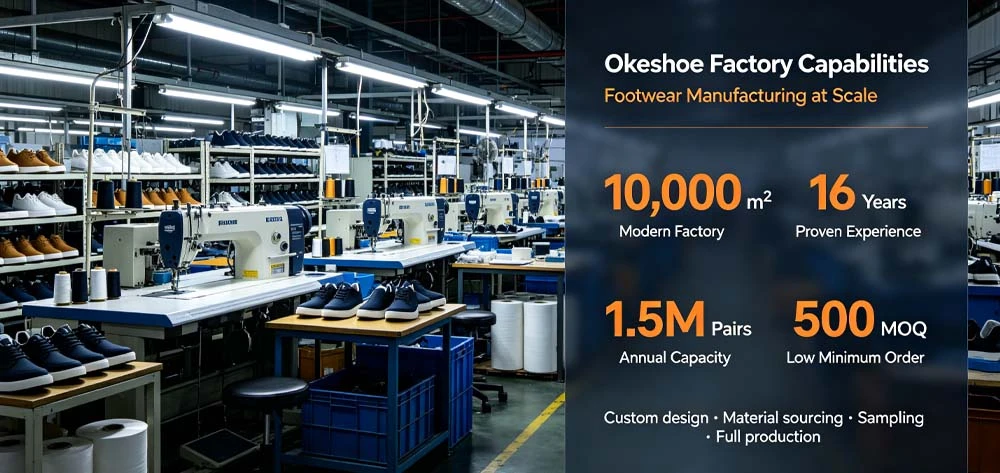
Okeshoe sits deliberately in the low-MOQ band: 500 pairs per style, 10 assembly lines, 200+ production staff across 10,000 m², and 1.5 million pairs a year of capacity across more than 1,000 styles developed for 100+ brand partners and 300+ clients globally. Since 2010 — 16 years — that has meant most custom sneakers projects start as semi-custom and only move to a new mould once the silhouette proves itself.
The tooling question deserves its own paragraph, because it is where money is lost quietly. A new outsole mould costs USD 1,200–3,500 depending on complexity and number of sizes, and it is usually amortised across the first order. Ask three things in writing: who owns the mould, where it is stored, and what happens to it if you move to another factory. A professional manufacturer should clearly define mould ownership, storage arrangements and usage rights before production begins.
💡 Frequently Asked Questions
What is the minimum order quantity for private label sneakers?
Specialised manufacturers may accept orders starting from 500 pairs per style, while larger production facilities commonly require 1,000–3,000 pairs. Colour variations may share the same MOQ, whereas developing a new outsole mould involves separate tooling costs.
Okeshoe’s Material Sourcing and Cost Advantages
Material selection and sourcing efficiency directly influence sneaker production costs. With 16 years of manufacturing experience, Okeshoe coordinates material procurement, development and production to help brands balance material quality, product performance and target pricing.
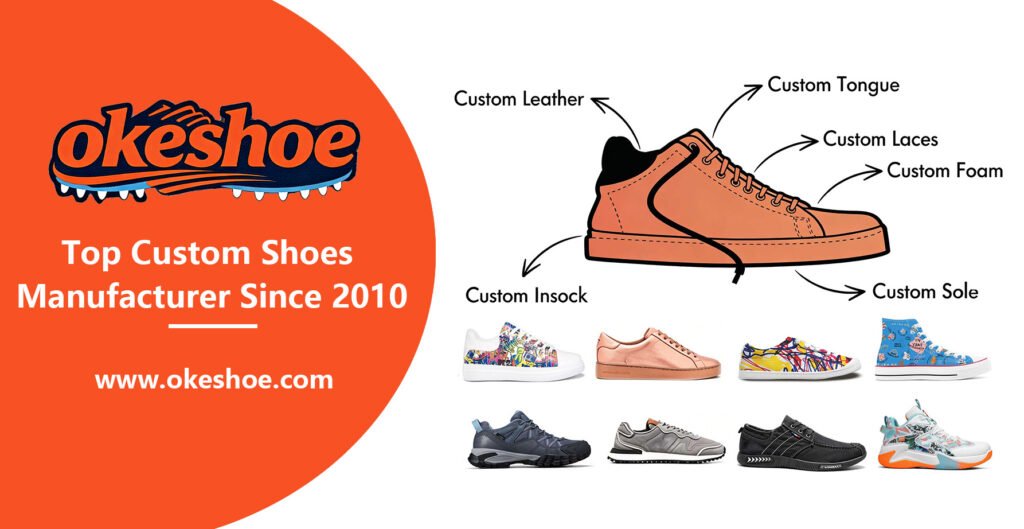
- Flexible Material Selection: Supports engineered knit, mesh, canvas, synthetic leather, suede, EVA, phylon, PU, rubber and TPU to accommodate different footwear styles and price positioning.
- Cost-Effective Material Sourcing: Evaluates material specifications, supplier options and purchasing volumes to identify cost-saving opportunities without compromising essential product requirements.
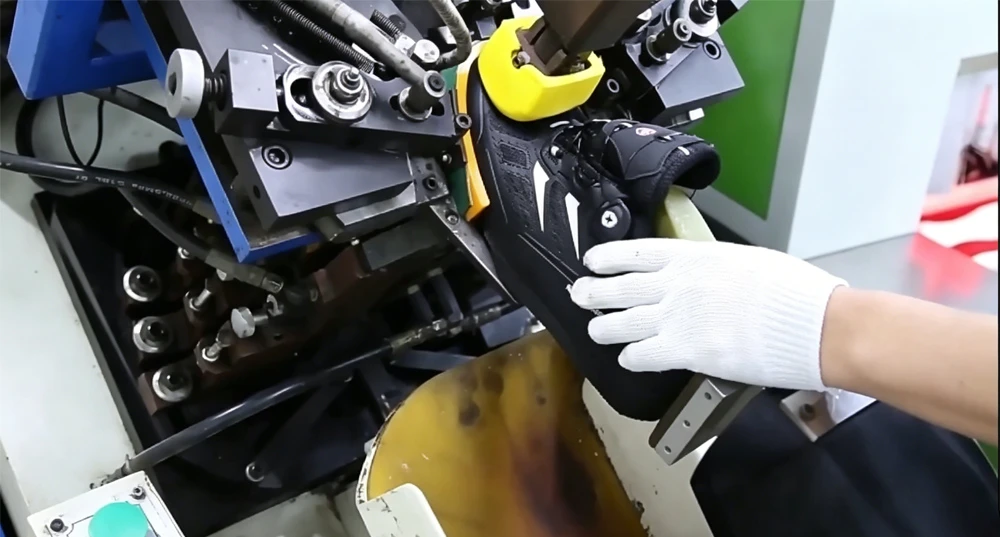
- Integrated Production Capabilities: With 10 production lines, 200+ production staff and a 10,000 m² factory, Okeshoe coordinates material preparation, cutting, stitching and shoe assembly to improve production efficiency.
- Flexible Order Quantities: A 500-pair MOQ per style allows brands to test new designs and manage initial purchasing costs before expanding production.
- Scalable Manufacturing Capacity: An annual capacity of 1.5 million pairs supports both developing brands and established footwear businesses with ongoing production requirements.
By combining material selection expertise, coordinated manufacturing and flexible order arrangements, Okeshoe helps buyers manage material costs while maintaining consistent product specifications across production batches.
Start Your Custom Sneaker Project with Okeshoe
With 16 years of experience, a 1.5 million-pair annual capacity and a 500-pair MOQ, Okeshoe provides flexible sneaker manufacturing solutions for global brands. Contact us today for a customized quotation and free samples.
| OEM&ODM Factory | Email: sandy@okeshoe.com | WhatsApp:+86 13328871615 |
Material selection directly affects sneaker manufacturing costs, product durability and overall market positioning. From upper fabrics and midsole compounds to outsole materials and lining specifications, every component should be evaluated against performance requirements and target pricing.
For brands comparing custom sneakers factory options or sourcing through private label sneaker manufacturers, the right partner should offer more than competitive pricing. Material expertise, production capacity, quality control and flexible customization are equally important for building a reliable footwear supply chain.
By evaluating these factors before placing an order, buyers can control production costs, reduce quality risks and develop custom sneakers that meet both customer expectations and commercial objectives.