Scaling a footwear brand from a digital concept to thousands of high-quality physical pairs requires a manufacturing partner with proven industrial expertise. Understanding how a professional custom shoe factory transitions unique design specifications into high-volume, standardized production lines is critical for global buyers, fashion designers, and procurement managers.
At Okeshoe, we demystify the industrial manufacturing process. By leveraging 16 years of OEM/ODM manufacturing excellence, cutting-edge automated assembly, and stringent quality control protocols, we turn complex custom footwear blueprints into market-ready bulk shipments efficiently.
Key Takeaways: How a Custom Shoe Factory Crafts Bulk Footwear
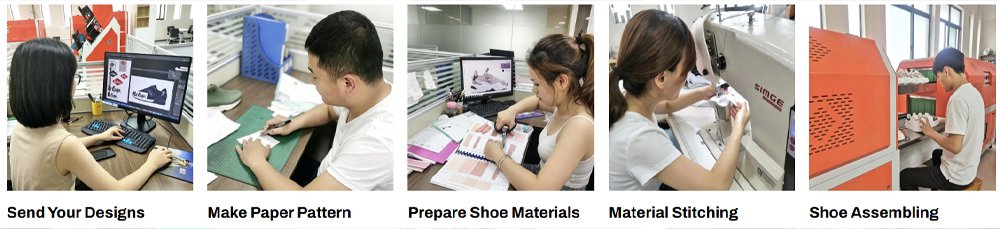
- Step 1: Industrial Blueprinting & Tooling: Converting brand tech packs into graded physical shoe lasts, outsole injection molds, and CNC cutting templates across all target size runs.
- Step 2: Automated Material Preparation: Utilizing computerized laser cutters to section upper fabrics, eco-friendly synthetics, and genuine leathers with millimeter precision.
- Step 3: High-Volume Upper Stitching: Assembling tongues, linings, hardware, and structural panels across modular high-tension stitching lines.
- Step 4: Pneumatic Lasting & Assembly: Stretching stitched uppers over graded lasts, roughening bottom surfaces, and bonding soles under automated hydraulic pressure.
- Step 5: Rigorous QC & Certification Testing: Conducting inline stress checks and third-party lab testing (BV/SGS/TUV) before final packaging and export shipping.
Inside Okeshoe: A Trusted Custom Shoe Vendor
Behind every successful footwear line is a flexible manufacturing system engineered to manage small-batch versatility alongside massive industrial output. As an established custom shoe vendor, Okeshoe operates a specialized manufacturing hub designed for seamless scaling across classic casual shoes, canvas sneakers, skate footwear, and modern athleisure lines.
Our facility bridges the gap between emerging fashion labels and high-volume retail buyers by combining flexible minimum order limits with massive underlying factory throughput.
| Factory Spec | Industrial Data | Buyer Advantage |
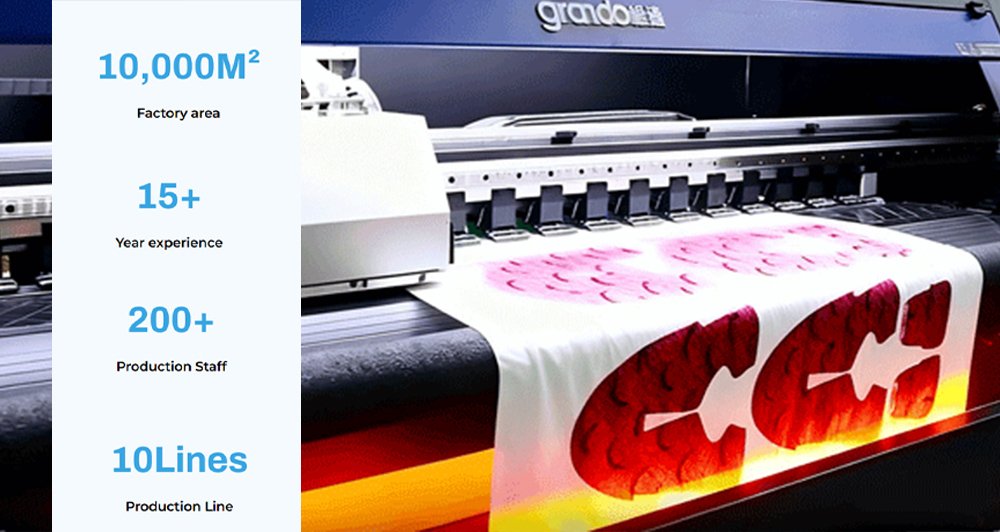
| Facility Footprint | 10,000 m² | Ample space for simultaneous bulk storage and multi-line assembly operations |
| Workforce Expertise | 200+ skilled shoemakers & technicians | Guarantees exact execution of complex material techniques and structural details |
| Assembly Infrastructure | 150 stitching lines / 10 durable lasting lines | High-flexibility cellular manufacturing supporting multi-style mass runs |
| MOQ & Capacity | MOQ 500 pairs / Capacity 1,500,000+ pairs/year | Lowers entry barriers for startups while ensuring rapid restocking for major brands |
💡 Frequently Asked Questions
- Q: How does a custom shoe vendor balance low MOQs with mass production efficiency?
- A: Modern facilities like Okeshoe utilize flexible cellular manufacturing. As a dedicated custom shoe vendor, standardizing core outsole molds while running modular stitching lines allows us to process flexible orders from 500 pairs up to tens of thousands without halting main assembly machinery.
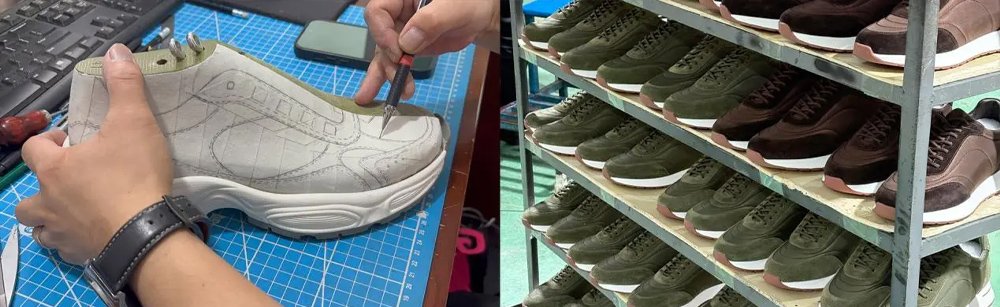
Transitioning Custom Designs to Bulk Shoe Lasts and Tooling
The transition from a customized shoe prototype to thousands of uniform pairs hinges on precise engineering standardizations. A premier custom shoe manufacturing partner converts brand tech packs into physical Master Footwear Lasts and precise mechanical tooling through a structured engineering sequence:
- Digital CAD 3D Modeling: Converting original brand sketches and sample measurements into precise digital 3D models to map volumetric fit and ergonomic arch curves.
- Non-Linear Last Grading: Scaling the master shoe last across all target size runs. Engineers make non-linear adjustments to instep height, forefoot width, and heel width to preserve identical comfort across every size.
- Custom Tooling Fabrication: CNC-milling or casting durable steel and aluminum injection molds for custom outsoles, heel counters, toe caps, and branded hardware accents.
- Production Line Calibration: Cutting master physical pattern dies for every shoe component, ensuring complete structural consistency when full-scale cutting begins.
💡 Frequently Asked Questions
- Q: What tooling prep is required before bulk production begins in custom shoe manufacturing?
- A: Once the initial prototype is approved, a full-service custom shoe manufacturing team produces customized outsole injection molds, grade-specific upper cutting dies, and structural heel counters across all target size runs, ensuring complete structural consistency for the entire shipment.
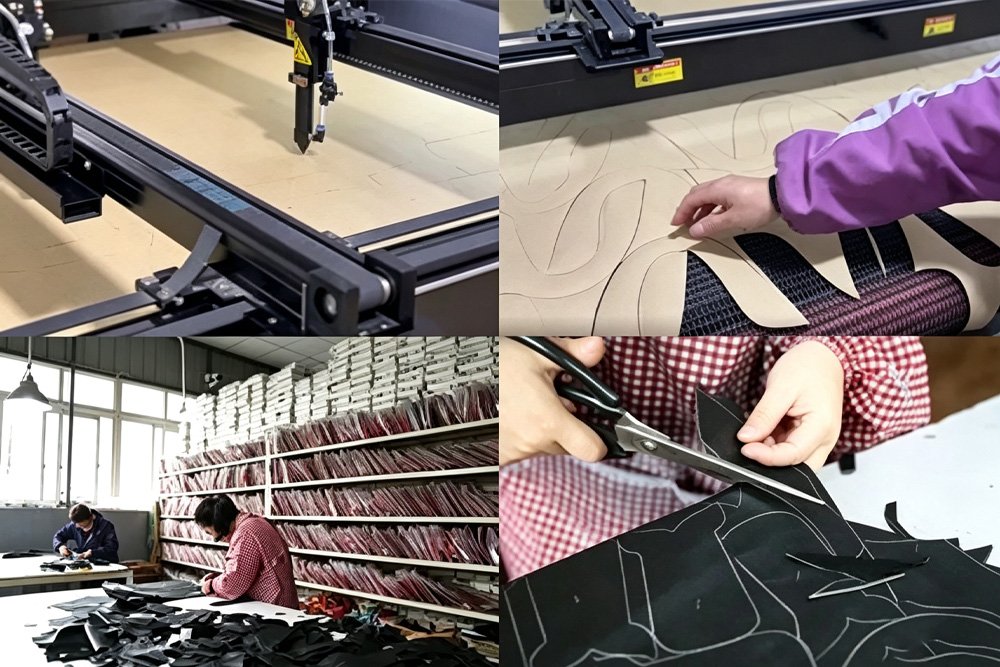
Precision Material Cutting and Upper Stitching for Large Orders
Once physical tooling is calibrated, raw materials—ranging from high-performance breathable textiles and premium genuine leathers to eco-friendly recycled soles—enter the cutting and stitching workshops. Achieving consistency in bulk footwear production requires eliminating human error during component prep.
At Okeshoe, computer-controlled CNC laser cutters automatically lay out upper patterns onto fabric sheets, maximizing yield and minimizing material waste. The cut panels move across our 150 stitching lines, where technicians install custom padded tongues, ergonomic insoles, structural eyelets, and customized lining materials using high-tension lockstitch machinery.
- CNC Precision Cutting: Tolerance controlled within $\pm 0.5\text{ mm}$, guaranteeing multi-layer alignment and clean edge finishing.
- Anti-Deformation Reinforcement: Integrating high-tensile anti-stretch tape at critical stress points to prevent upper distortion during heavy lasting.
- Modular Upper Assembly: Parallel stitching lines process tongues, collars, and lateral quarters simultaneously before final high-strength structural joining.
💡 Frequently Asked Questions
- Q: How do factories ensure color and size uniformity across bulk footwear production?
- A: Robust bulk footwear production relies on computerized automated pattern cutters (CNC) for millimeter-level precision, paired with strict material lot-number matching to eliminate batch-to-batch color shifts and physical sizing discrepancies.
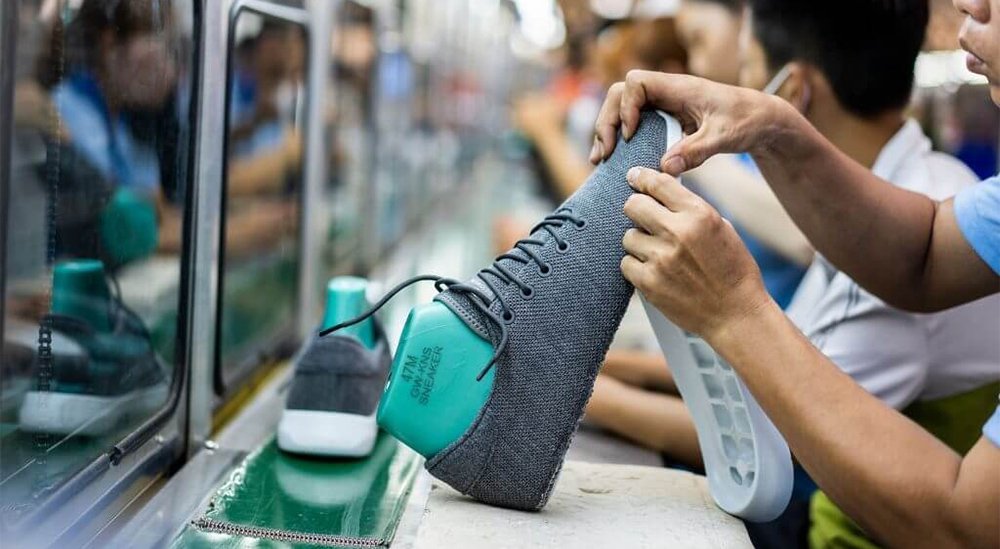
The Cold-Cementing and Sole Assembly Process in Mass Production
The core phase of mass shoe manufacturing takes place on the physical lasting and assembly line. Depending on the shoe architecture—such as casual vulcanized sneakers or cemented athleisure runners—the upper and sole must undergo rigorous chemical and thermal bonding.
In our primary footwear assembly process, uppers are pulled tightly over the graded shoe lasts using automated pneumatic toe-lasting machines. The bottom of the lasted upper is roughened, coated with specialized industrial primers, and bonded to the outsole under high-pressure sole presses.
Bonding Strength Threshold > 30 N/cm
Footwear Assembly Process: Upper Lasting → Surface Roughening & Priming → Adhesive Coating & Flash Drying → High-Pressure Sole Pressing → Cold Chilling Chamber Solidifying
💡 Frequently Asked Questions
- Q: What controls the bonding strength between custom outsoles and uppers during the footwear assembly process?
- A: In any modern footwear assembly process, bonding integrity relies on precise mechanical surface roughening, infrared adhesive drying temperatures, and pressurized hydraulic pressing (typically 4 to 5 kg/c㎡), preventing delamination during wear.
Strict Quality Control and Fast Replenishment at Our Reliable Shoe Factory
Quality assurance is embedded throughout every step of mass manufacturing, preventing bulk returns and preserving brand equity. As a reliable shoe factory servicing over 300+ global clients and 100+ global brand partners, Okeshoe implements First Article Inspection (FAI) combined with inline physical testing.
Every completed production run undergoes strict physical stress tests, including flexing endurance, outsole abrasion resistance, and seam-pull force checks. Our quality management system and ethical production standards are certified by renowned third-party inspection bodies, including BV (Bureau Veritas), TUV, and SGS. Furthermore, our robust material inventory enables rapid order replenishment for top-performing footwear SKUs.
| Inspection Item | Testing Standard | Recognized Certifications |
| Sole Bonding Strength | ≥35 N/cm | BV (Bureau Veritas) |
| Flex Resistance | No cracking after 40,000+ continuous flex cycles | SGS Certified |
| Abrasion Resistance | Abrasion volume ≤ 150mm³ | TUV Rheinland |
| Final Pass Rate | ≥ 99.2 % final inspection acceptance rate | ISO 9001 Quality System |
💡 Frequently Asked Questions
- Q: What third-party physical inspections confirm that you are working with a reliable shoe factory?
- A: A reliable shoe factory submits mass production samples to laboratory testing for outsole abrasion, sole flexing endurance, color crocking, upper seam strength, and chemical safety, validated through official SGS, BV, or TUV certification reports.
| OEM&ODM Factory | Email: sandy@okeshoe.com | WhatsApp:+86 13328871615 |
Navigating the transition from shoe design concepts to seamless mass production requires a manufacturing vendor with deep industrial roots. As an industry-leading custom shoe factory, Okeshoe delivers reliable, high-volume footwear production tailored to your exact business requirements through 16 years of manufacturing experience, a 10,000㎡ operational footprint, 150 stitching lines, and BV/SGS/TUV certified quality.
Whether you need a rapid replenishment run or are launching a new private-label collection with our low 500-pair MOQ, our engineering team is ready to assist.
Contact us today to claim your free sample and launch your next high-performance footwear collection!