Key Takeaways
- Raw Material Compliance: Verify fabrics and leather via SGS, BV, and TUV standards to eliminate eco and physical defects.
- Sole Durability Testing: Okeshoe enforces a 4.0 kg/cm peel strength and <150 mm³ abrasion loss to prevent delamination.
- Fit Tolerance Control: Utilize 200+ skilled craftsmen to maintain critical dimensions within ±1.0 mm for uniform sizing.
- Logo Craft Audit: Apply 3M tape tests and 8-10 stitches/inch checks to guarantee logo adhesion and aesthetic finish.
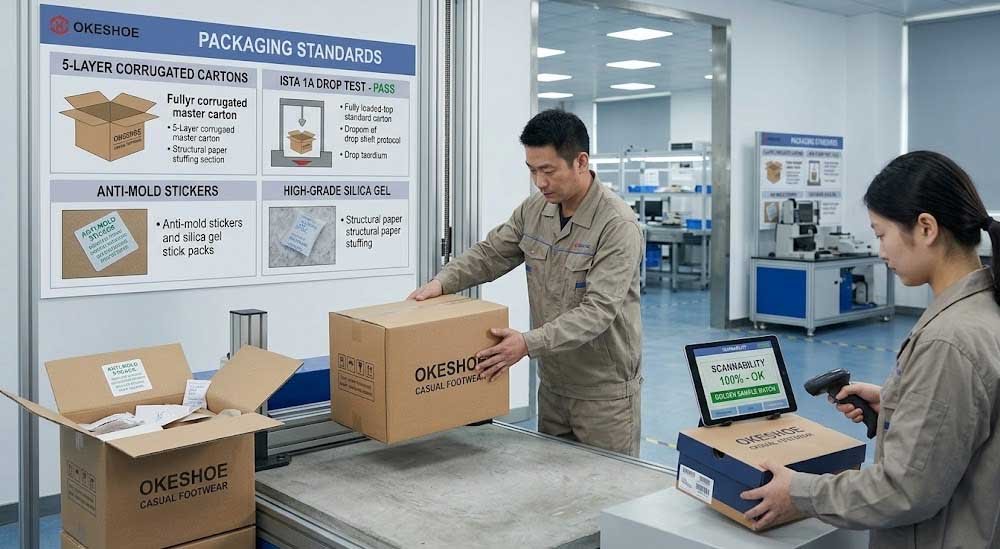
- ISTA Packaging Standards: Use 5-layer cartons with ISTA 1A drop testing and silica gel to ensure zero transit damage.
In cross-border footwear supply chain management, quality fluctuations are the primary driver of customer returns, chargebacks, and long-term brand equity erosion. For overseas brand owners, wholesalers, and sourcing agents, mastering a clear, quantifiable QA/QC inspection framework is the single most critical safeguard for reliable supply chain execution.
As a premier China-based casual shoes manufacturer with 16 years of production experience, Okeshoe operates a 10,000 m² modern manufacturing facility powered by 200+ skilled workers. Delivering over 1.5 million pairs of high-quality shoes annually to more than 300 global brand partners, we integrate ISO9001 and SGS international testing standards into every stage of production for custom casual shoes.
Draw from our front-line manufacturing expertise, this article breaks down a comprehensive B2B quality control checklist across 5 core dimensions to help buyers systematically eliminate defects and optimize shipment pass rates at our casual shoes factory.
Material Inspection Guide
As a professional casual shoes supplier, verifying the compliance of raw fabrics and leather before cutting determines the ultimate product feel, durability, and safety. Systematic batch sampling prevents shade variations and material flaws from cascading down the production line:
- Physical Property Testing: Conduct tensile strength and tear resistance tests on mesh, canvas, genuine leather, and synthetic leather before cutting.
- Colorfastness Audit: Utilize a Crockmeter for dry and wet crocking tests, requiring a minimum Grade 4 rating to prevent dye transfer during wear.
- Environmental Compliance Certification: For orders destined for North America and Europe, adhesives, uppers, and foam materials must hold valid SGS, BV, or TUV certifications to restrict phthalates, heavy metals, and AZO dyes.
💡 Frequently Asked Questions
Q: How do B2B buyers verify eco-friendly materials for custom casual shoes?
A: Reliable suppliers provide official test reports from certified third parties like SGS, BV, or TUV, confirming that raw materials comply with EU REACH or US California Proposition 65 restricted substance lists.

Sole Durability Testing
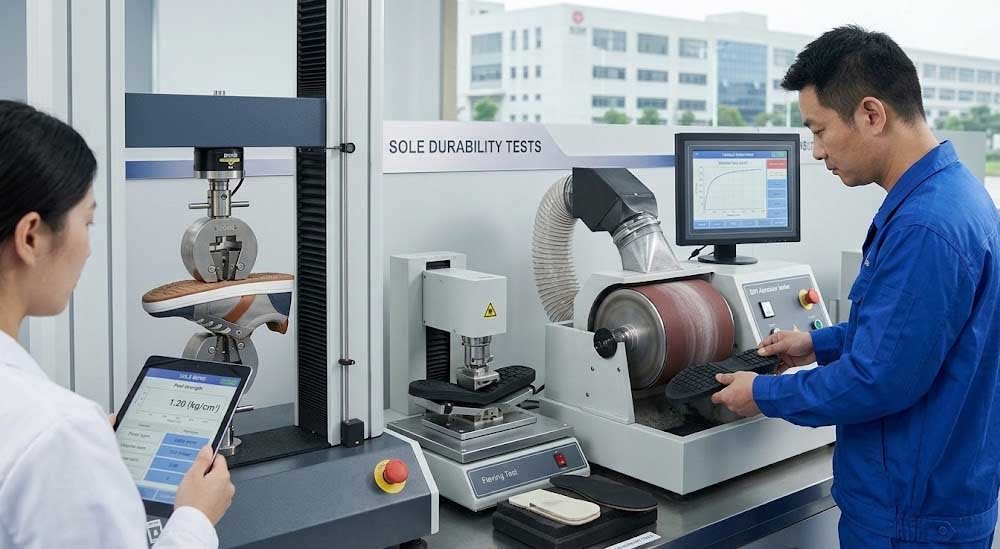
The outsole structure directly absorbs daily impact stresses. Delamination (sole opening) and outsole cracking represent two of the most costly defect categories in B2B footwear sourcing. Consequently, sole bond strength and abrasion resistance form the core of the bottoming QC phase:
- Peel Strength Testing: Employ an electronic tensile tester on the upper-to-sole bond, holding a minimum industrial standard of 4.0 kg/cm (39.2 N/cm) to resist continuous flexing without delamination.
- Abrasion Resistance Testing: Measure rubber or EVA outsole volume loss using Akron or DIN abrasion testers, maintaining wear loss strictly under 150 mm³.
- Slip Resistance Evaluation: Test static and dynamic friction coefficients on wet and dry surfaces using slip resistance meters to ensure compliance with global safety standards.
💡 Frequently Asked Questions
Q: What is the acceptable peel strength for casual shoe soles in mass production?
A: International industrial standards require a minimum peel strength of 4.0 kg/cm (39.2 N/cm) between the upper and outsole to prevent premature delamination under stress.
Fit Tolerance Control
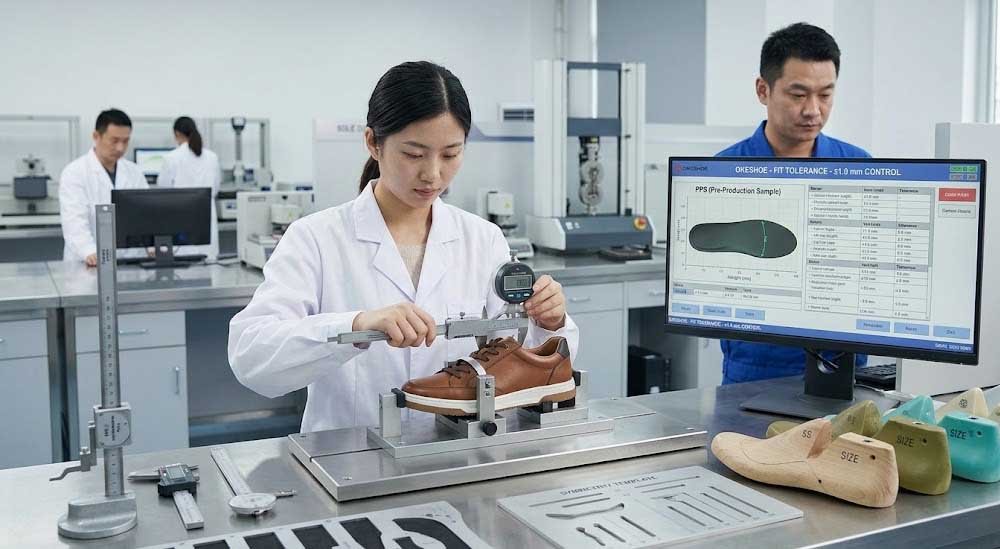
Inconsistent sizing generates severe retail return rates. During mass production, the precise calibration of shoe lasts and heat-setting durations govern overall shape retention and dimensional accuracy:
- Dimensional Tolerance Checks: Measure shoe length, ball width, heel height, and left-right symmetry with standard insole gauges and calipers, maintaining a strict tolerance within ±1.0 mm.
- Cold/Heat Shaping Controls: Utilize 200+ experienced technicians alongside automated cold and heat setting machinery to guarantee optimal dwell times and temperature regulation for a stable shoe cavity.
- Fitting Consistency: Cross-check mass production samples against signed Pre-Production Samples (PPS) to deliver uniform wear comfort across global markets.
💡 Frequently Asked Questions
Q: How can B2B buyers minimize sizing errors in bulk casual shoe orders?
A: Establish a strict pre-production sample (PPS) sign-off protocol with your factory, establishing maximum dimension tolerance thresholds (usually within ±1.0 mm) against standard shoe lasts.
Logo Craft Audit
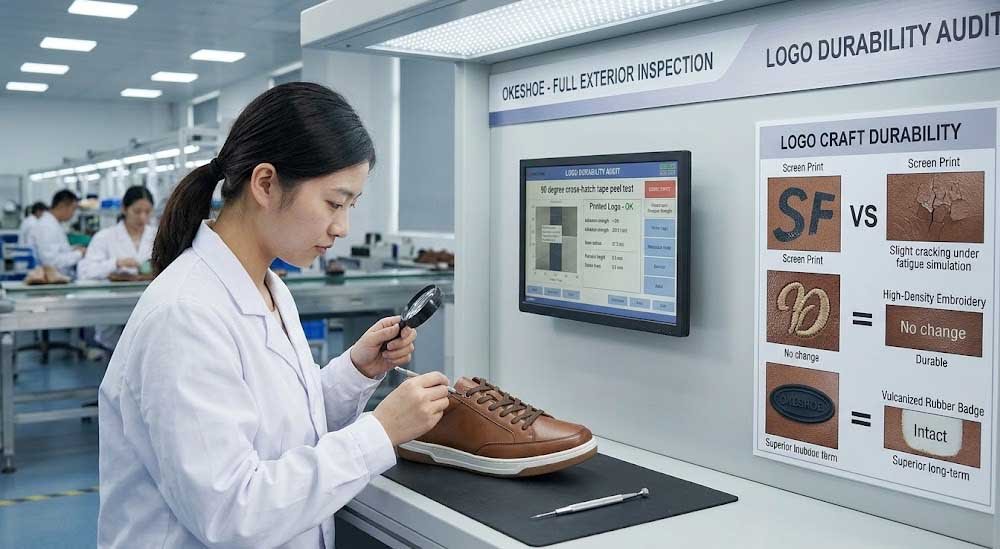
Brand logos and aesthetic finishing details drive product premiumization and brand recall. Custom shoe manufacturing demands precise quality inspection protocols across screen printing, embroidery, debossing, and heat transfer applications:
- Placement & Density Verification: Inspect high-density embroidery and silicone heat-transfer logos for layout alignment, edge stitch density, and visual sharpness.
- Adhesion & Wear Resistance: Perform a 3M 90-degree cross-hatch tape peel test on printed and heat-transferred logos to ensure zero flaking or cracking after repeated flexing.
- Full Exterior Inspection: Inspect every pair for loose thread trimming, stitch density (8-10 stitches/inch), hardware anti-rust plating, and smooth trim adhesion to maintain a clean finish.
💡 Frequently Asked Questions
Q: Which logo application method provides the highest durability for custom casual shoes?
A: High-density embroidery, debossed leather patches, and vulcanized rubber badges offer superior long-term durability and fatigue resistance compared to standard surface screen printing.
Packaging Standards
Export packaging extends beyond visual branding—it serves as the essential safeguard against crushing, moisture, and mold during long-distance maritime shipping and warehouse storage:
- Physical Drop Testing: Conduct A3/ISTA 1A drop tests on fully loaded master cartons, dropping along 1 corner, 3 edges, and 6 faces to verify carton integrity and inner shoe box protection.
- Moisture & Mold Protection: Line master cartons with anti-mold stickers, calibrated silica gel desiccant packs, and insert structural shoe trees and paper stuffed into shoe cavities.
- Visual & Code Audits: Match custom shoe box color accuracy, lamination smoothness, and barcode scannability 100% against approved Golden Samples.
💡 Frequently Asked Questions
Q: What protective packaging standards should international B2B shoe buyers require?
A: Buyers should require 5-layer corrugated master cartons passing ISTA drop tests, high-grade moisture-absorbing silica gel, anti-mold stickers, and reinforced tissue paper wrapping.
Ready to Scale Your Footwear Brand with Zero-Defect Manufacturing?
As a premier China-based casual shoes manufacturer with 16 years of expertise, Okeshoe operates a 10,000 m² state-of-the-art facility with 10 production lines and a 1.5 million pair annual capacity. We support flexible customization from styles and materials to logos and packaging—all with a low MOQ of 500 pairs.
Contact us today to claim your free sample and partner with a trusted supplier certified by BV, TUV, and SGS!
| OEM&ODM Factory | Email: sandy@okeshoe.com | WhatsApp:+86 13328871615 |
A rigorous QA/QC management system is the ultimate safeguard for a resilient B2B footwear supply chain. From incoming raw material verification and dynamic pull-testing on assembly lines to final drop and anti-mold packaging audits, each standardized protocol reflects modern shoemaking engineering precision.
Combining 16 years of specialized manufacturing, international certifications (BV, TUV, SGS), and agile production capacity, Okeshoe remains committed to offering cost-effective, zero-defect manufacturing solutions for global brand partners. Partner with an expert casual shoes supplier to make quality control the cornerstone of your brand’s international expansion.